Of course no one organization can solve this problem. Everyone involved, including the clubs, fans, players, police and those responsible for stewarding, has a responsibility here (UEFA President and CEO)
In stadiums throughout Europe, Black athletes are made to bear the indignities and humiliations of racial abuse. Racial attitudes toward black athletes seem to be part of the football fabric in European leagues. In this atmosphere, athletic prowess or misses incite intense hatred inducing verbal abuse and physical threats. Players of African descent are often confronted with a barrage of racial abuses, monkey chants and banana peels used as projectiles doubled as insults.
On Saturday, February 26, 2006, Samuel Eto’o from Cameroon, overwhelmed by racial epithets and abuses threatened to leave the pitch during a game opposing his team, FC Barcelona to Zaragoza, also in Spain. The incident drew major media attention because Eto’o was a well renowned player. In 2013, Kevin Prince Boateng, a German born player of Ghanaian descent also walked off the pitch during a game under similar circumstances. Furthermore, on May 13, 2013, Kevin Prince Boateng, Mario Balotelli, and other black players like the Ghanaian Suley Muntari endured racial abuses from a group AS Roma supporters during an Italian Série A game in Milan. This past summer, Seydou Keita, a Malian player refused to shake hands with Pepe, a Portuguese player after a friendly game in Dallas, TX. Pepe in retaliation spat on Keita who then threw a water bottle at him. This incident stemmed from a previous encounter between the two players when Pepe had called Keita a monkey years before when they both played in Spain. The episode was reported by Radio France International[1] and got some media coverage but less than a similar incident would have generated if it had occurred at a more mediatized game or competition. High profile leagues, teams, players and more importantly the global live broadcasting of the games have helped expose racist incidents and made it harder for all to ignore or deny them. But for the media and live coverage of games, most racist incidents and abuses would still remain as localized anomalies or unverified anecdotes. Indeed, in less mediatized European leagues in Eastern Europe for instance, the overt abuse of black players and other minority players is only episodically reported. This is particularly true for lower division clubs that do not receive as much media attention.
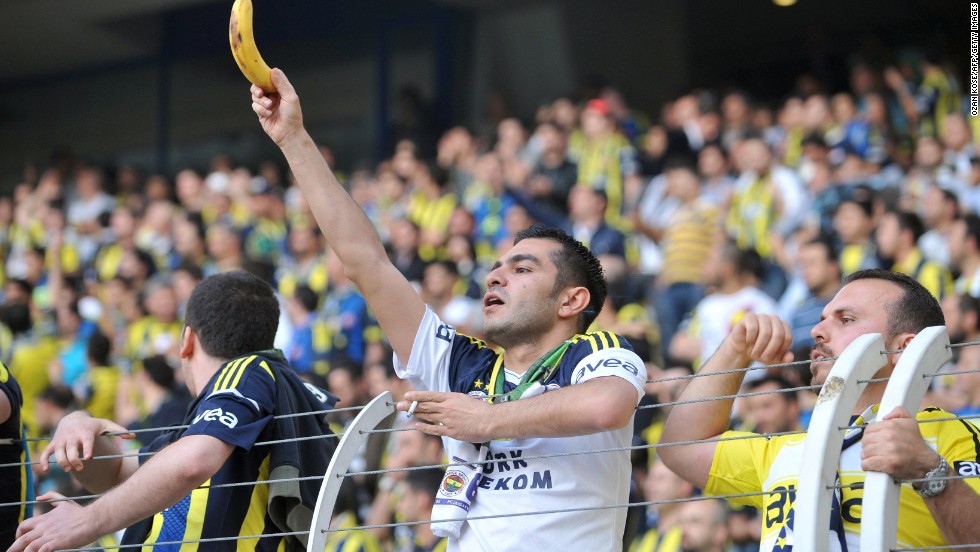
Racial slurs and threats are then often trivialized, denied, and/or swept under the rugs as attacked players developed or are suggested coping mechanisms to safeguard their careers. Denials and coping mechanisms are one of the insidious characteristics of contemporary racism within the elite and educated populations. Utterances such as “I’m not racist, I have black friends, I hang out with blacks” are common among individuals trying to defend themselves against a racist label. Luis Aragon’s[2] (a coach from Spain) illustrated the individual denial as well as the public denial. “I cannot understand when I have gipsy, yellow, black friends, this is not me”[3] exclaimed a visibly outraged and offended Luis Aragon in 2004 when he was confronted with the racist remarks he made about Henry Thierry. The Spanish Federation added insult to injury by publicly denying the importance of the episode and by leveling a fine of $5,000 on Aragon. Furthermore, they allowed him to coach the Spanish national team a few months later into the FIFA World Cup. In another incident, when supporters of a Montenegro team targeted Beasley, an African America player with their monkey chants, Veselin Tomovic said the monkey chants were common among the Montenegro fans and were not specifically aimed at Beasley. “Our fans chant that to their opponents all the time, it has nothing to do with the color of skin,” he said. With African players in quest of a career in Europe, the denial and trivialization of racism in football is a strategic choice in achieving their career goal. The investment and high expectations from their families in Africa encourage docility. Most of these players were first generation immigrants from Africa in search of a career. They were not organized nor did they have the political ability to protest against racist abuses or contest the denials of their predicaments.
With the growing number of second generation of immigrants, players of African and Caribbean descent brought the anti-African racism into the forefront of European societies. Overt racism against second generation immigrant players (most of them born and raised in Europe) is much more difficult to carry out as was the case with the game between England national team and Spain in November 17, 2004[4], where the abuses seemed more like attacks on European teams. UEFA President Lennart Johansson and Chief Executive Gerhard Aigner offered the following statement:
The problem of racism is a real issue for the European football family and for the image of football in general […] Of course racism at our games is a sad reflection of society in general, but, because of the high-profile nature of football on our continent, we have a particular responsibility to take steps to stamp it out and prevent it occurring in the future.

Over the years, the global media coverage of European major leagues helped bring to light racism in football and several organizations have started to openly address the issue. FIFA (Federation International Football Association) officially started to tackle the race issue right before the 2006 World Cup. In conjunction with UNICEF, FIFA launched the “No To Racism” campaign during the World Cup 2006. On March 16, 2007, FIFA also launched “Show Racism the Red Card” that symbolically means the expulsion of racism from the game. In addition, strong actions and policies were put in place to fight racism in football. FIFA disciplinary code, Article 58[5], has six paragraphs of policies against racism. The FIFA “Say No to Racism” banner became a common pregame image for FIFA competitions. Racism is openly discussed and integrated into media campaigns for international federations. UEFA “No To Racism”; FIFA “Say No To Racism”; and Corporations such as Nike’s “Stand Up Speak Up”[6] are examples of institutional actions against racism. Organizations such a Football Against Racism in Europe (FARE)[7] has also become an important player in campaigns against racism and discrimination.
Despite the aggressive anti-racism campaigns, external factors seem to temper real progress and changes. Thus, the rise of extreme right political parties in European countries has reinvigorated shameless xenophobic and racial discourses on the public stage. Former France president Nicola Sarkozy and British Prime minister Gordon Brown for instance, chose to glorify the “civilizing” mission and accomplishment of their nations’ colonial ideologies. Also, despite fines, suspensions and increasing media attention, negative stereotypes as vestiges of racism in football are often expressed and maintained through popular culture, the media, and the arts.
Hopefully, racism in football is no longer a taboo topic and with wide demographic changes, the denial of racism in the sport has become more difficult. As stated before, the second generation of African players is European and is less likely to accept and/or accommodate slurs and racist attacks. After all, as they play more and more as integral parts of European national team, insulting them equates to insulting European national teams. The ethnic frontiers associated with racial differences do not hold anymore and the African descent player is not completely the “Other” either. It would however be naïve to expect that football can singlehandedly change European societies and how they relate to the African “Other.” As stated by Gerard Dreyfus, a French journalist “we cannot ask football to solve societies problems. However football is contributing to confronting the ugliness of racism and discrimination in Europe.” We ignore or deny everything around us yet when it happens in a stadium it’s become visible and claimed unacceptable. The construction of the Black as “Other” closer to the monkey than the human has centuries of consistent dissemination. Despite many efforts to deconstruct such design, countless well spread images and discourses about black across the globe sustain the status of black people as the “Other”. It will take a major philosophical revolution of the dominant global-media and all societies to honestly start debunking centuries long of the ideological and philosophical construction of the African and African descent less-human status. Football and sport in general may contribute to the transformation, but will not achieve it.
Authors: Gerard Akindes and Sessi Aboh
[1] Seydou Keita: «c’est inacceptable qu’un autre homme me crache dessus » http://www.rfi.fr/afrique-foot/20140730-seydou-keita-est-inacceptable-autre-homme-me-crache-dessus/?ns_campaign=reseaux_sociaux&ns_source=FB&ns_mchannel=social&ns_linkname=editorial&aef_campaign_ref=partage_aef&aef_campaign_date=2014-07-30
[2] http://www.telegraph.co.uk/sport/football/international/2387995/Spain-coach-in-the-dock-over-Henry-race-slur.html
[3] Id.
[4] http://news.bbc.co.uk/sport2/hi/football/internationals/4018421.stm
[5] http://www.fifa.com/mm/document/affederation/administration/fifa_dc_en_34118.pdf
[6] http://nikeinc.com/news/thierry-henry-and-fellow-players-call-on-fans-to-fight-racism
[7] http://www.farenet.org/